 Contact Us
 (877) 248-1631
Understanding the keyway dimension that is often overlooked
When discussing a keyway, most machinists immediately focus on two dimensions: width and length. However, there is a third dimension that plays a major role in tooling selection and broaching feasibility.
CNC Broach Tools refers to this radial depth as the Height of Groove, or H.O.G. While many prints do not specifically call out this dimension by name, it is a dimension that is often overlooked in keyway quoting and tooling selection.
Understanding the Height of Groove early in the process can help prevent tooling mismatches and eliminate unnecessary delays.
What Is the Height of Groove?
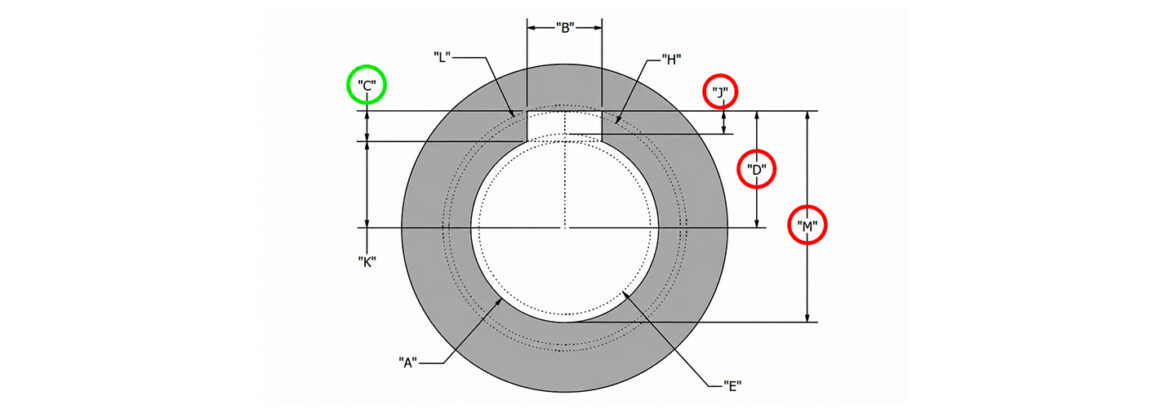
The Height of Groove refers to the radial depth of the keyway. It is the distance from the top of the keyway to the bottom of the groove measured radially within the bore.
A keyway contains three primary dimensions:
- Width
- Length (axial)
- Radial depth
The Height of Groove is that radial depth measurement.
Because engineering prints often provide bore dimensions and keyway callouts rather than directly specifying the radial depth, the H.O.G. value is often calculated from the bore and keyway dimensions.
Why the Height of Groove Matters
Every broach insert has a maximum amount of cutting height available above the tool body. This determines the maximum Height of Groove that the insert can produce.
If the required groove depth exceeds the insert’s capability, the setup may not be suitable for that particular insert or toolholder combination. This is why Height of Groove is an important consideration during the quoting process.
When evaluating a broaching application, checking the H.O.G. dimension is just as important as verifying the keyway width and bore size.
A keyway may appear straightforward at first glance, but the radial depth requirement often determines which tooling options are available.
Why This Dimension Is Often Missed
Unlike keyway width, the Height of Groove is not always clearly identified on a print. Engineers frequently provide dimensions to the bore and the top of the keyway, leaving the radial depth to be determined from the drawing.
This can create confusion when discussing a new application. It is common for the axial length of the keyway to be mistaken for the groove depth, even though these dimensions serve completely different purposes.
From a broaching standpoint, the radial depth is often one of the first dimensions reviewed because it directly affects insert selection.
How Height of Groove Affects Tool Selection
As the required groove depth increases, the insert must project farther above the tool body to reach the bottom of the keyway.
This creates practical limitations based on bore size and holder geometry. A small bore may not provide enough clearance for a larger tool body capable of supporting a deeper groove.
Because of these constraints, non-standard groove depths may require a different insert, a different holder configuration, or a custom tooling solution.
Understanding the Height of Groove before selecting tooling helps ensure the application is matched to the correct broaching system from the start.
A Small Dimension with a Big Impact
The Height of Groove is a critical dimension in CNC broaching because it directly influences tool selection, insert projection, and whether a standard tooling solution can be used.
Before quoting or programming a keyway, it is worth taking the time to verify the required radial depth. A simple calculation early in the process can help avoid tooling limitations, improve quoting accuracy, and ensure the broaching operation is set up for success.
